Forest Green Eco Grden Res
Amazing Power : Om Gam Ganapataye Namaha Chanting Meditation
On Galapagos Island there is little botanical fauna where the Iguanas first see light. The reptile is left to hatch on a pebbled beach terrace. The snakes hide in the rocks nearby. The predators know when the iguana eggs hatch and sneaks up to the newly borns as they are about to escape to the hill tops. Watch movie here
I am referring to the video sent on Trust Family Network in early June this year. Meghan Markle on Sky News Live announces the opening of the Plastic Free Trust Mark in Iclandic grocery shopping malls. Richard Walker, managing director of the Plastic Free Trust Mark in Iceland states the clarity of the trademark. The customer can distinguish between the plastic packaging and natural material of cellulose and cardboard material.
The Limping Dolphin is replaced with Plastic Free trade mark to state in clear marketing terms the imminent need to change shoppers habits. The black type on white background makes the message crystal clear on packaging that could otherwise risk the customer a moment of doubt whilst hanging over the open buffet ice box in a multi brand grocery hall.
Shoppers are informed about making an eco-friendly choice when entering their hands into the open refrigerated cooler containing frozen vegetables and meat products. Plastic Free Trust Mark awards retailers that are willing and able to take on the new trend in cardboard and celluloses packaging material.
The award benefits merchants whose incentive has been motivated by plastic free branding. Big retail groups have adopted the trading scheme and earns a mark-up on their smaller retail stores whose products are awarded with trademark “Plastic Free”.
Iceland has pledged to make all their retail packaging plastic free by 2023.
Richard Walker points out to the audience at the launch that there is the classic chicken and egg dilemma. The demand for plastic free emballage increases the number of trades and the cost drops on products branded with the label “Plastic Free”. A neutral cost on material supplied to the plastic free trade mark shown on embellage packaging makes the customer favour eco-friendly product from the plastic wrapped stuff.
Plastic Planet has launched a teaser on grocery products that has a small plastic window. The cardboard material holds a transparent window in the middle of the tea pig tea bag wrapping material has made ready for the plastic free shopping shelf. The tea pig bag can viewed through an embelage material made out of celluloses of wood stock from a nearby newly planted forest.
Mrs. Sian Sutherland has heard a polly-dolly gossip in town. The strawberry plants’ leaves and stalks are being exploited for use in the packaging industry. As they mak a pulp when processed serves the same purpose as does cardboard material. However, the strawberry plant can be treated as compost.
Plastic Free has made a long term commitment to export plastic free packaging material to their trusted retail partners at market place all through Britain.
See a link related to the subject matter in article by James Murray in Business Green.https://www.businessgreen.com/bg/news/3024503/iceland-vows-to-become-worlds-first-plastic-free-supermarket
In late April the Wilhelmsen family represented by family business owners Emily and Agnes served The Wilstar Company on the slopes of Nyanza at Kakamega Agricultural District. North West shore of Lake Victoria we were addressed social labour policies for the disempowered women threatened by delinquency at an early age. The Ministry of Agriculture is funded b VisionFund a financial aid program under the auspicious guidance of OneAcreFund and RootCapital. The latter is organized by the Ministry of Finance with direct foreign aid programmed supervised by Michael Fisher KickStart Brand.
The labour force has supervision by Young Empowerment Institute (YEI) organized by the Minster of Social Affairs. The age group 11 – 18 years of age youth that leave school in search of paid work in the suburbs of Nairobi is a vulnerable age group. A potential future employee at a garden centre tending to legumes, fruits, pulses and beans they are paid a low salary and enter into traditional female positions. At age 16 – 24 the labour force has an increasing number of female labour contracts listed with YEI. However, age group beyond 22 the male labour force takes the majority of the vacancies offered in town of Nairobi.
The KickStart Brand offers a MoneyMaker sales program for male workers to learn to handle manual “treadmill” water pump. The task force is speialized in translating the American user manual into their own Kikuyu language, travel to county districts and sell treadmill water pumps to middle size farming households and less wealthy smallholders. The KickStart water aid has been enforced by philanthropic organizations. Number one in the world is Carer International. Their Norwegian Branch Office has approved of a mandate managed by Marcus Bleasdale. The A Wilhelmsen Company has funded Michael Fisher´s blue painted water pump sales with NOK3Mill. Blue Venture has fulfilled the first philanthropic milestone at the outskirt of Nairobi and on the slopes of Nyanza at Kakamega, one of East Africa´s most populated areas.
Steps are taken by The Skoll Foundation, the Wilstar philanthropic backbone to overcome exhaustion when working the “treadmill” water pump. ILO has raised the issue regarding child labour. Smallholder families raise on average 5-6 children per household. The 1-2 of the farmer´s children are required to take part in powering the water pump. Their body weight is insufficient to meet the minimum of water flow over the manifold. One acre of land is hard to moisten in case there is an environmental shock and the draught hits hard on their small patch of land. The water pump is designed to suite farmer´s brothers and sisters. They take their turn pumping in tandem. Two at a time jump on the water mill and kicks off with their 45-55kg body weight. However, solar panels are offered to the families able to save more than US$200 over the course of a planting and harvest season.
In the picture there is the parentes at a smallholder farm in the outskirt of West Nairobi. The workman puts all his weight on the levers. The water hose pulls water out of the water well just 10 meters to his right. The manifold is mounted in the shaft by the steering stick. The water manifold circulates water through a oneway vent and pushes the water out 40-60 meters out into the one acre farm field. A brand new pump has a market value of US$40-60+ and has a minimum of movable parts, easy to dismantle and put together again. The market for garden water drip systems has increased as the water supply has significantly increased. The 10-15m tube end of the hose is pierced and let water percolate onto the ground. The women and male farmers find their salad heads, spinach plants and green cabbage easily targeted with a drip.
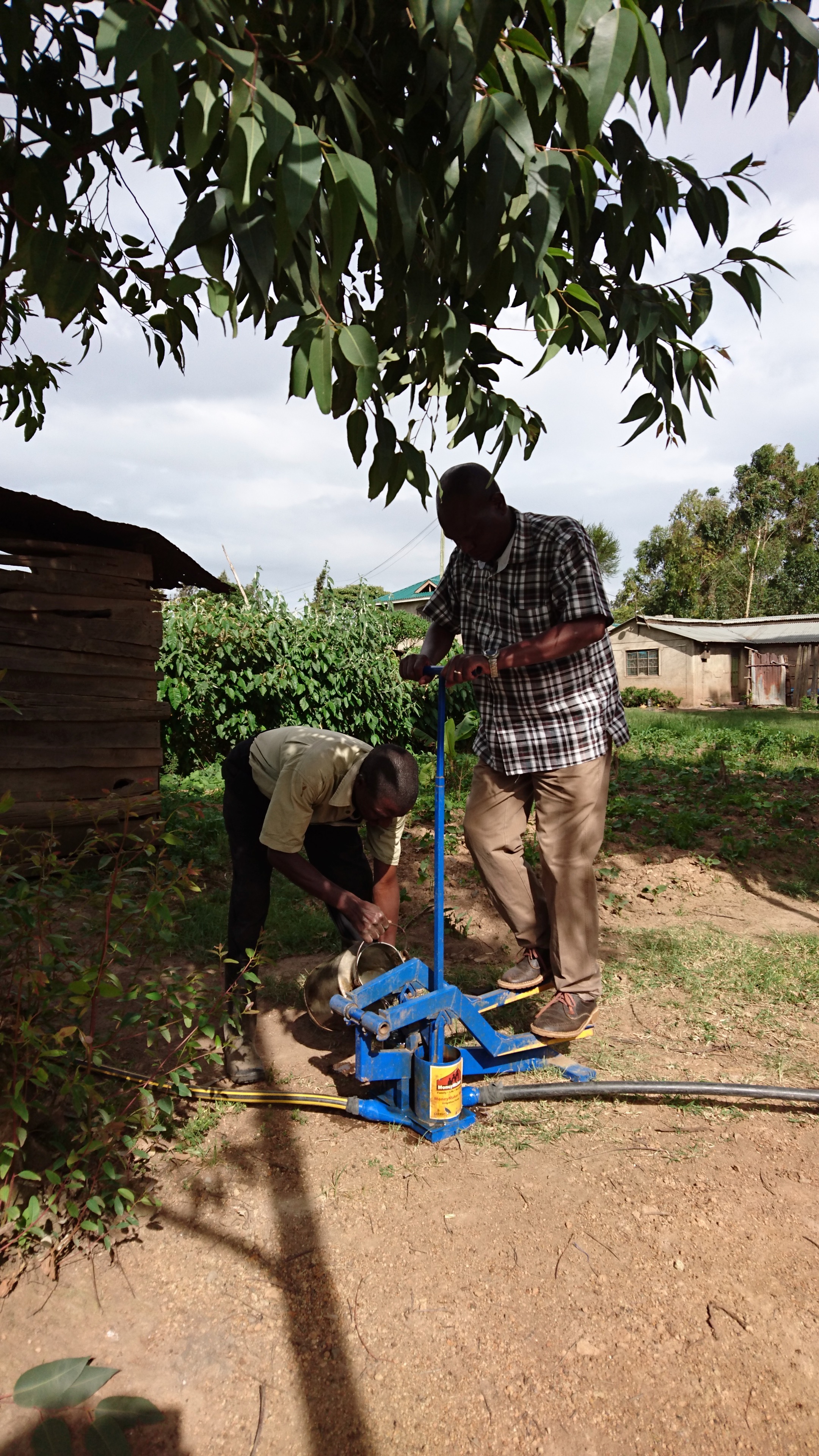
The popular “treadmill” brand from KickStart has literary kickstarted a work force of smallholders capable of overcoming the water shortage. The short rain season March – July has short-rain season prolonged into the long-rain season. This environmental shock caused by a lack of daytime long-rain occurring 1-2 months in late summer, is prevented. The KickStart pump replaces the rain that failed them. Hence the risk of draught on their one acre is reduced and and the greens can be harvest as usual twice a or even three times a year in places.
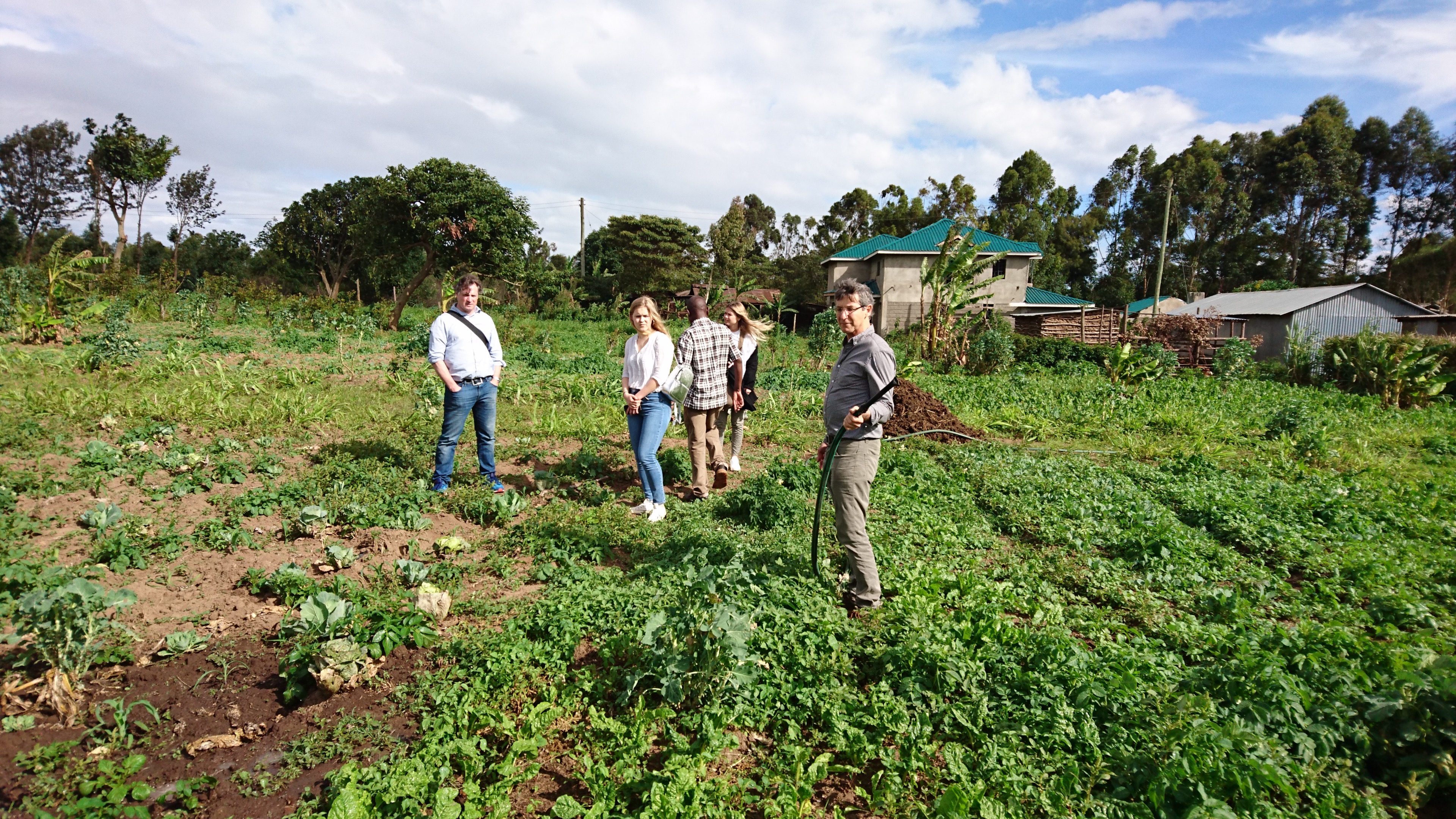
The green growth of the vegetable garden has plummeted for the farmers we visited and their purchase power increased. If the farming family withholds family expansion plans, harvest and sell legume to the market place, saves money through the long rain season in the fall and should make them ready to purchase Michael Fisher´s solar pump. A solar panel purchase saves their living children from standing turns by the water pump. The solar panel work hours save them sweating under the scorching tropical sun. They could go to the market place, buy themselves GreenPlanet Lamp and extend some of their home work hours under the light powered by their new solar panel. A panel yields sufficient electric power to set off 10 40Watt lanps. The electric energy storage releases electric current during the evening. The remaining power on the battery is stored over the night and drains in the morning hours when the sun rises and powers the panel again.
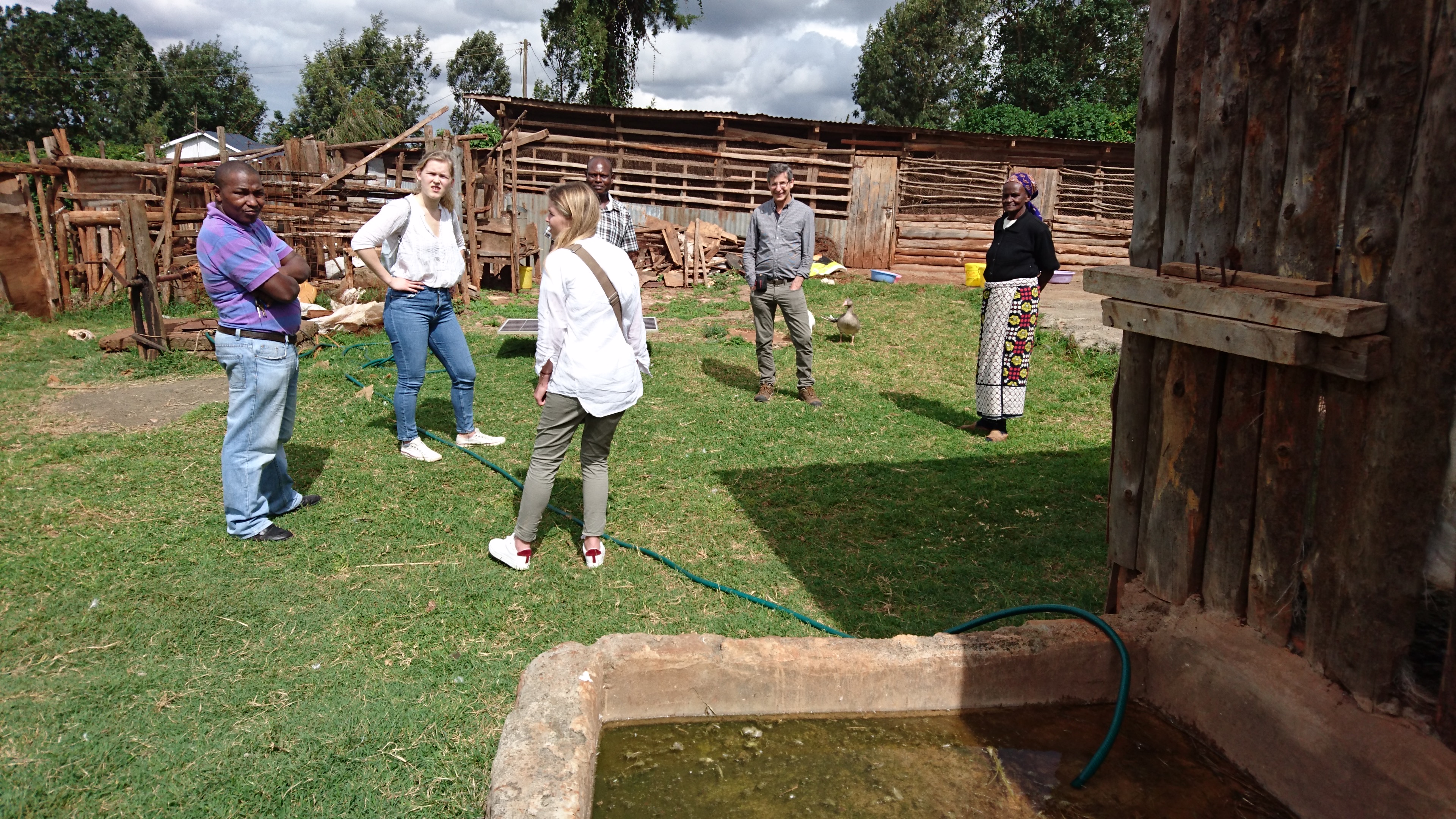
In the picture a farmer next door to Charles is Lillian. She sold 150 non-hatching chickens in the market. The sale of poultry earned her a fortune. She spent 4/5 of the sales to purchase a solar pump from Alan Spybey, marketing and sales director at KickStart Workshop in Nairobi. The solar panel is visible behind the family secretary standing with her back to the camera man.
Site map Focus klick here
Traditionally, smallholder families collect water in water buckets from a river stream. Water pumps have been something to suite the hardworking community of farmers. The rural farmer is limited on one acre of land. There is a pressure on the rural farmer to limit the number of children to afford education and make money to improve standard of living. A solar powered water pump is tailored for the purpose.
The standard of living in rural outskirts of Kakamega compared with Nairobi is caused by climate change. Environmental shocks trigger smallholder families to act on sales promoted by MoneyMaker a district sales force trained by the Michael Fisher sales team. The marketing campaign is supervised by Allan Spybey at KickStart, Nairobi, a hydro-mechanics tech firm sponsored by VisonFund that again is governed by the Skoll Foundation situated in Palo Alto California.
The agricultural districts located just North Eastern cost of Lake Victoria holds a high atmospheric pressure. The moisture content remains high over the course of the day. A short-rain season retains the water in the air until middle go July. A prolonged draught lasts until late August. Then the long rain season sets in in early September. The long rain period extends over the course of the day and males the soil very wet. In fact, the soil goes runny and surface water flows over over the ground and makes streams form.
The beginning of the rainy season cause small siblings to grow on the fertile soil dampened from night rains. The humidity hovers over the lake. The humid air is blown over the slopes to north eastern slopes of the inland lake. The humid air strikes the colder air over the forested land area north of Kisumu town.
The early growth of the soil fertilizes the soil layers beneath the surface. The tropical temperature varies within a band of 2-3 degrees per season. The moist fresh air is rich in live and wild Nitrogen gases. In the outskirts of the big city the common bean seeds lie ready in a warehouse. The agricultural planting program has allocated stacks of the stuff for distribution to OneAcreFund field workers. A specific breed of the bean named “the lab-lab bean” is chosen by field officers and prepared for distribution to a community of smallholders. These hardworking farmers are conscious of the fact that the bean can absorb free ranging Nitrogen in the air. The lab-lab bean holds the bio-chemical quality of attracting bacteria to its root system.
In the soil layers beneath a certain bacteria is attracted by the lab-lab knob residuals formed on root stem. Some microorganisms attach to them and feeds off Nitrogen gases present on the root surface. Just below the surface organisms thrive. The bacteria live in symbiosis through-out the host plant´s lifetime. Bacteria life does last no longer than 5-8 hours. Then other bacteria takes hold of the root and continues the cycle. The biological cycle is termed Rhizobia. Lab-lab is the colloquial term put on the common bean. The seedlings are tailored to fertilise the earth, restore soil organic matter ready made for seasons of seed planting to come year after year.
The unique properties contained in the process is called rhizobia. The farmer cluster committed to planting common bean of this kind intercrop the grain with maize. Their staple food is enriched by a protein-rich foodstuff. The food supplement improves their diet. The change in staple foods makes their bodies more tolerant to hard work. More prolonged dry season, shorter short rain and maize crop less tolerant to army worms cause the maize yields to drop year in year out. An intercropped fields maintain an active Nitrogen fixing cycle. The maize contains the Nitrogen in the soil while the lab-lab bean extracts the wild gas from the air. The maize is fed on a soil more rich in micro-organisms. The fungi develops a resilient network of microbes. The conductivity is enhanced by an increase in Nitrogen fixation from two crop yields paired up on the acre.
The demand for a water pump has more potential as the farming families has a more healthy diet. A starch rich one-sided diet based on maize is no longer depended on a single crop. The common bean added to the food cycle maintains a balanced diet for the hardworking smallholder.
A farming community embraces a cluster of farms. The smallholder conserves a common farming policy contained in the national agricultural heath plan. One cluster consists of eight to fifteen smallholders. The cultivation of common bean intercropped with maize is organized under the leadership of a field officer. The competitive advantage contained in harvesting two crops in one season has these advantages to the crop farmer:
The lab-lab bean fertilizes the soil in the process called rhizobia . The nitrogen rich soil contained in the lab-lab root system prepares the common bean for the uptake of minerals rich Iron, Calcium and Magnum all vital for the healthy growth of bone marrow, muscle and skin tissue.
Andrew Yuon keynote address at University of Berkeley California view here
 Forest Garden Plant Root and Petal Remedies